Selling a car online: what to blur in the photos
You have washed the car, taken twenty photos on the drive, and you are about to paste them into a classifieds listing or a local Facebook group. Ten minutes on those photos now is worth a great deal later. This page goes through what to cover, what to leave completely clear, and the point at which obscuring things starts to cost you buyers.
The registration plate
Called a number plate in Britain and Ireland, a license plate in the United States and Canada, and a registration plate on the paperwork almost everywhere. It is the first thing to cover and the one most sellers forget.
Start with the plate, because it is the only thing in a car advert that is a unique public identifier and is trivial to copy.
A registration number on its own opens more than most sellers expect. Anyone can type it into the DVLA's vehicle enquiry service on GOV.UK and get back the tax rate and expiry, SORN status, MOT expiry, the date of first registration, the year of manufacture, engine size, fuel type, emissions figures, weight, the export marker, and the date the V5C log book was last issued. The separate MOT history service takes the same registration and returns every test since 2005, including the mileage recorded at each one and the parts that failed or were logged as minor problems.
None of that is a scandal. It is public deliberately, and a serious buyer will look at it before they ring you. Note what is not in there: DVLA does not hand out the registered keeper's name or address through that service, and says so on the page — obtaining keeper details means writing to them with a reason.
The concrete risk is cloning. Someone with a car of the same make, model and colour can order plates carrying your registration and drive on them, which is why the reg is worth the effort while the mileage is not. The RAC's guide to car cloning describes where the numbers come from in one sentence: "Often criminals can locate number plates to clone online, for example via images on car buying and selling websites." Automatic number plate recognition does not know which of the two cars it photographed, so penalty charges, toll and clean-air charges and speeding notices are issued to the registered keeper of the plate. That is you, and unpicking it takes weeks of correspondence with parking companies and councils that have no reason to believe you first time.
The plate does not give away your address by itself. It does the moment it appears in the same listing as a photo of your house number, because at that point nobody has to look anything up.
The VIN
The vehicle identification number is a 17-character string unique to the car. It shows up in more photographs than people realise: stamped or etched at the base of the windscreen on the driver's side and readable through the glass, printed on a sticker or plate on the driver's door pillar where the door shuts, sometimes stamped in the engine bay or under the boot floor, and printed on the V5C.
Buyers want it for good reasons. Comparing the VIN on the car against the VIN on the paperwork is exactly the check that catches a cloned or ringed vehicle, and GOV.UK's vehicle recall service accepts either a registration or a VIN. A buyer who asks for it is behaving sensibly.
The sensible middle path is to keep it out of the public advert and give it to a named individual who is genuinely proceeding — by message, or when they arrive to view the car. In practice that means checking two shots: the close-up through the windscreen corner that shows the VIN plate, and the open-door shot that shows the pillar sticker. A wide front-three-quarter photo will not resolve the characters. A modern phone camera at the base of the windscreen absolutely will.
Documents carry your name and address
Sellers photograph paperwork to prove provenance, which is a good instinct badly executed. A UK V5C carries the registered keeper's name and address, the VIN, the engine number and the document reference number. DVLA's own guidance, in its digital services post on staying safe online from March 2023, is blunt: "if you post pictures of your official documents such as your log book (V5C) or driving licence, scammers can steal your information to commit fraud". The same post adds that you should not share the V5C document reference number, "particularly to a prospective purchaser". Registration documents in other countries differ in name and layout, but they carry the same three things: an owner or keeper name, an address, and a document number.
The rest of the folder is no better. Service history books are usually stamped with your name. MOT certificates carry the test number and an address. Insurance certificates carry a policy number. A finance settlement letter carries an account number and, often, a balance. Receipts stapled into the back of the book carry a card's last four digits.
You can still prove the car has been looked after. Photograph the fanned-out stamps and the invoices, then black out the text that identifies you before the picture leaves your phone: the name and address block, the document numbers, the account numbers. Keep the dates, the mileages and the garage names, which are the parts a buyer actually reads.
The shot that shows where the car sleeps
A car advert is a public notice that a specific, valuable, movable object is kept at a particular place, illustrated with a photograph of exactly what it looks like. Everything in the background that narrows down that place is worth a second look:
- The house number on the door, the porch, the bins or the gatepost.
- The street sign at the end of the drive, and estate signs at the entrance.
- A neighbour's plate parked behind yours, which is their registration, not yours, to publish.
- The front of the house being identifiable at all — an unusual door, a conservatory, a house name.
- Named landmarks over the roofline: a pub sign, a school, a church, a chain shop with a branch name.
The best fix here is not editing at all. Drive somewhere neutral and photograph the car there: an empty corner of a supermarket car park, an industrial estate on a Sunday morning, a lay-by with a hedge behind it. Plain backgrounds make better advert photos anyway, and nothing needs covering afterwards.
Reflections, the dashboard and the cabin
Clean paint is a mirror. Doors, bonnet and boot lid reflect whatever is in front of them, which is usually you holding a phone, the house behind you, the other car on the drive and sometimes the number on the door. Glass reflects the street. Before you post, open your three favourite shots at full size and look at the panels rather than through them.
Inside the car, work through the screen and the windscreen:
- A satnav or infotainment screen showing a saved home address, or a route with "Home" and a distance on it.
- A paired phone name in the Bluetooth menu, which is frequently a full first name and surname.
- A recent call list or contact list left on screen.
- A residents' parking permit on the windscreen, which carries an address, a zone and a permit number.
- A workplace or hospital parking permit, which tells a stranger where you spend your weekdays.
- A child seat still strapped in, which says a child lives at the address in the background.
- A lanyard, ID badge or delivery label on the passenger seat.
One dashboard shot is worth taking properly rather than hiding: the odometer. Buyers compare it against the mileages in the MOT history, so make sure the number in your photo and the number in the advert match what the record shows. A discrepancy you cannot explain will kill more sales than a covered plate ever will.
A checklist before you post
- Cover the registration plate in every photo it appears in, front and rear, including reflections in shop windows and puddles.
- Check the windscreen base and the open-door pillar shots for a legible VIN.
- Cover the name, address and document numbers on any photo of the V5C, service book, MOT certificate, insurance document or finance letter.
- Scan the background of every exterior shot for house numbers, street signs and neighbours' plates.
- Look at the reflections in the paint and glass at full zoom.
- Check the infotainment screen for a home address, a paired phone name or a contact list.
- Check the windscreen for parking permits and the cabin for permits, badges and child seats.
- Strip the location metadata if the photos were taken at home.
- Read your own advert text for the details the photos no longer give away: your street, your workplace, the times the house is empty.
- Add one line offering the registration, the VIN and the full documents to a genuine buyer.
Do not over-blur: the advert still has to sell the car
This is the part most guides skip. Buyers are wary of listings where everything is smudged. Blur eight photos out of ten and the advert reads as either a scam or a car with something to hide, and the enquiries dry up. The balance is not difficult, but it has to be deliberate.
Cover three things: the plate, a legible VIN, and any document. Leave everything else completely clear. Photograph the paint in daylight, the wheels including the kerbing, all four seats, the boot, the engine bay, the tyres, and every dent and scratch you know about. A seller who photographs the damage looks honest, and honesty is what a covered plate can otherwise undermine.
Then say so in the advert, in one plain sentence: the registration is covered in the photos, and you will share the registration, the VIN and the full service history with anyone who is seriously interested. That sentence does the work. It converts a covered plate from a warning sign into an obvious precaution, and it tells the buyer they can still run a history check before they travel.
It also puts you in a better position than posting the reg publicly. A plate in a listing is available to everyone who scrolls past, with no record of who copied it. A plate you send in a reply goes to one named account at the moment they ask, which is both a smaller audience and a useful filter.
A last point on appearance: a neat, tight black bar over a plate looks intentional. A smeared blur dragged across half the bumper looks like a botched edit, and buyers read it that way. Draw the box to the edges of the plate and no further.
Covering the plate on this site
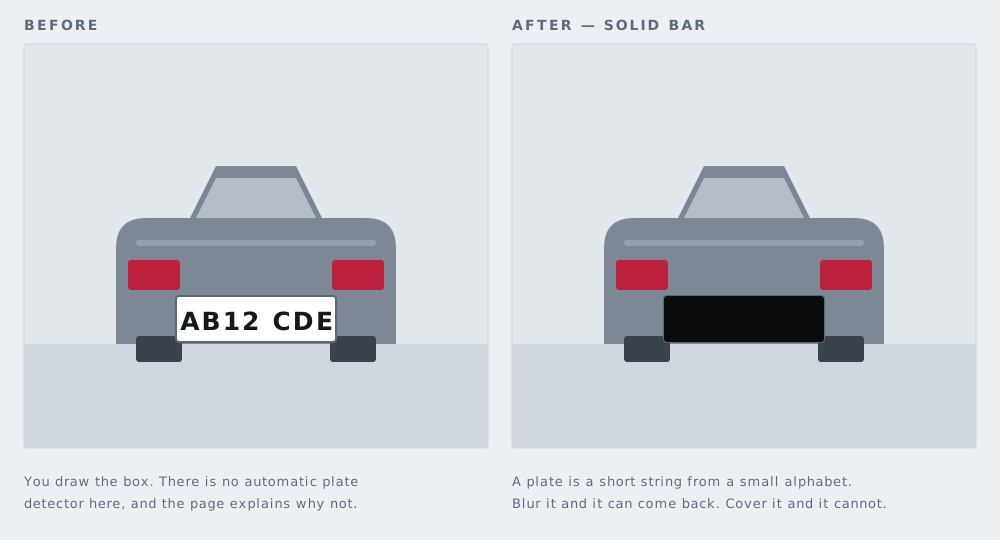
Face detection here is automatic: pick a file and your browser downloads Google's MediaPipe BlazeFace model, then marks the faces it finds. Plates are different. There is no automatic plate detection on this site, because there is no reliable, permissively licensed plate model that runs in a browser, and pretending otherwise would be worse than saying it. You draw one box over the plate yourself using the license plate tool, which takes a couple of seconds per photo.
Use a solid bar rather than a blur. Blur and pixelation are filters laid over pixels that are still partly present, and a registration is a short string drawn from a small, structured character set, so anyone attempting to recover it has very few candidates to test. A solid bar replaces the pixels outright and nothing can bring them back. It is the default here for that reason, and the trade-offs between the three are set out in blur, pixelate or black box.
Everything runs in your own browser. The photo is opened by the page and never uploaded, to us or to anyone else, which matters when the file also shows the front of your house. Exports are PNG at the original resolution, or JPG, with no watermark, no sign-up and no limits. Re-encoding through the canvas also drops the EXIF metadata, GPS coordinates included, so an edited photo taken on your drive no longer carries your drive's coordinates. For photos you are posting unedited, there is a separate metadata stripper. The site handles JPG, PNG, WebP, GIF, BMP, AVIF, SVG, HEIC and HEIF and TIFF; camera RAW files are refused with an explanation, because browsers cannot decode them dependably. Still images only — not video, so a walkaround clip needs different tools.
Questions sellers ask
Should I hide the registration number from the advert completely?
Cover it in the photos and give it out privately to enquirers who ask. A plate in a public listing is available to everyone who scrolls past, with no record of who copied it. A plate sent in a message goes to one named person, at the point where they are serious enough to run a history check.
Will covering the plate put buyers off?
Not if you say why in the description. Covering the plate is common enough that some classifieds platforms do it for you: the Australian site carsales has blurred registration plates on uploaded listing photos automatically since 2019, citing plate cloning as the reason. One line in your advert offering the registration, the VIN and the full documents to a genuine buyer removes any suspicion.
Is a blur strong enough for a number plate?
A solid bar is the better choice. Blur and pixelation are filters applied over pixels that are still partly present, and a registration is a short string drawn from a small, structured set of characters, so there are few candidates to test against a recovered smear. A solid bar replaces those pixels outright and cannot be undone. It is the default on this site.
Do I need to remove the location data from the photos as well?
If you photographed the car on your own drive, yes. Phone photos routinely carry GPS coordinates in their EXIF metadata. Exporting an edited image from this site re-encodes it through the canvas, which drops the EXIF block including GPS. If you post a photo you have not edited, strip the metadata first.