What estate agents miss in listing photos
PUBLISHED 21 JULY 2026 · 7 MIN READ
A vendor rings the branch because their daughter's name is readable on a bedroom door in photo nine. Nobody was careless. The photographer was looking at the room; the camera was recording everything in it.
You compose for light, for the sightline through to the garden, for whether the sofa reads as too big. The lens does not know which parts of the frame you care about. A 12-megapixel photo is roughly 4000 by 3000 pixels, and a buyer who opens it on a laptop and zooms in gets every one of them.
Most of what follows is not a scandal. It is a phone call from an annoyed vendor, an awkward conversation with your branch manager, or a listing quietly pulled by a portal. That is reason enough to spend two minutes per photo.
What actually ends up in the frame
Faces on walls, shelves and the fridge door
Wedding photographs above the fireplace. School portraits climbing the stairs. A christening card on the mantelpiece with a first name and a date. The fridge door deserves its own look, because it collects magnets, a class photo and a child's painting, and the kitchen is in nearly every photo set. The occupier agreed to have their house marketed. They did not agree to have their sister's face on a national property portal.
Children's names, on doors and on artwork
Wooden letters spelling a name across a bedroom door. A painting signed in confident capitals and taped to a wall. Name labels on the school bags in the hall. A first name, plus a front elevation, plus the street in the listing header is enough for a stranger to sound convincingly familiar to a child.
The kitchen counter and the hall table
Prescription boxes carry a pharmacy label with the patient's name, address and the medicine. Repeat prescription slips get pinned to noticeboards and hospital appointment cards get stuck to fridges. Opened post sits on the hall table with the address showing through the envelope window. Health information about an identifiable person is the detail people are most sensitive about, and the one most likely to produce a complaint rather than a shrug.
You, reflected
Bathrooms are where photographers get caught. The room is small, you shoot from the doorway, and the mirror is pointing back at you. The mirror is not the only culprit: an oven door, a switched-off television, a chrome tap, a kettle and any framed print behind glass all return a picture of the room, and often of the person holding the camera.
Reflections carry more than people assume. Rob Jenkins at the University of York and Christie Kerr at the University of Glasgow published a study in PLOS ONE in December 2013 in which faces of bystanders were recovered from reflections in the corneas of photographic subjects. Observers who did not know those bystanders matched the recovered faces at 71 per cent accuracy; observers who knew them reached 84 per cent. A cornea is a few millimetres across. A bathroom mirror is not.
Your own face in a client's bathroom is rarely a privacy problem — you are not the vendor. It is a professional one. That is the image that gets screenshotted.
Outside the window and on the drive
A neighbour standing at their own kitchen window. Someone weeding next door. Children on the pavement in a front elevation shot. The vendor's car on the drive with a fully readable plate, and two or three more along the kerb. House numbers appear on the door, on the fanlight, on a slate by the porch, and in reflective vinyl on the wheelie bins. The bins are the ones people forget, because to the eye they are street furniture and to the camera they are text.
Screens, calendars and things a vendor may not want broadcast
A laptop left open on the worktop with a mail client on screen. A wall planner covered in names and appointments. A whiteboard with a mobile number on it. An alarm keypad beside the front door, or a key safe screwed to the wall by the porch. And there are items a vendor is comfortable with in their own hallway but not on a site with millions of visitors: a religious object, a party membership card on the noticeboard, a campaign poster in an upstairs window.
You do not need a policy on which of those matter. Ask the vendor at the appointment, before the camera comes out.
The portals have already written some of this down
This is not only a matter of taste. Rightmove's agent and developer technical guidelines, in the January 2026 version, state that an advert must not contain any photographs or static or animated images by which any living person can be identified, with an exception for rental operator and commercial members. The same paragraph requires that images are only of the property, land or immediate locale, that you hold the necessary permissions to use them, and that third-party intellectual property is blurred so that it is not identifiable.
The document is explicit about video too. It notes how easy it is to inadvertently record personal data such as family photographs or individuals when filming a virtual tour, and requires you to edit out anything that identifies a living individual.
One further rule is worth reading before you edit anything: images must not contain text, apart from an arrow or outline used to clarify location in something like a drone shot. That is aimed at banners and incentive overlays rather than at redaction, but it is a good argument for keeping a redaction plain. A black rectangle shaped to the object is a quieter edit than a caption explaining what you covered.
Other portals set their own criteria and they are not identical. Check the current guidelines for whichever platform you upload to, and check your own agency's policy as well, because it may be stricter than the portal's.
A listing is a public advertisement for a house that is often empty
Without drama: a complete photo set is a floor plan with an inventory attached. It shows the layout, which doors are glazed, whether there is a side gate, whether the rear garden is overlooked, what is worth taking, and whether an alarm is fitted. The address is published deliberately, and viewing arrangements imply when nobody is home. None of that is avoidable, because you are advertising a house for sale and buyers have to be able to see it.
The reasonable precautions are small and cost nothing. Do not publish a clear shot of the alarm keypad or the key safe. Do not publish a readable plate. Do not publish a close-up of a jewellery box, a gun cabinet or a laid-out watch collection. And ask the vendor whether they want the house number legible on the bins.
The two-minute check
Do this on the full-size file, not the thumbnail. Zoom to 100 per cent whenever you hit text. Work in the same order every time so it becomes automatic:
- Edges and corners first. The subject of the photo is usually fine; the problem is at the margin, where you were not looking.
- Every reflective surface: mirror, oven door, dark television, tap, kettle, microwave, glazed picture frame, glossy splashback.
- Every flat surface at hand height: worktops, hall table, chest of drawers, windowsill, bedside table.
- Every vertical surface: walls, fridge door, bedroom doors, noticeboards, the inside of open cupboard doors.
- Windows and doorways. What is outside, and what is visible through to the next room.
- Screens. Laptops, tablets, phones on charge, a paused television.
When to redact and when to reshoot
Reshoot when the fix improves the photograph anyway. Clearing a worktop, closing a laptop and moving a school bag out of the hall all make a better picture, not just a safer one. If the vendor is happy for you to move framed photographs off a mantelpiece, an empty mantelpiece looks better than a blurred one.
Redact when reshooting means a second visit: the light has changed, the vendor has moved out, or the photograph is otherwise the best one you took. Reflections, plates, house numbers on bins, a neighbour at a window and a name on a bedroom door are all better redacted than lost.
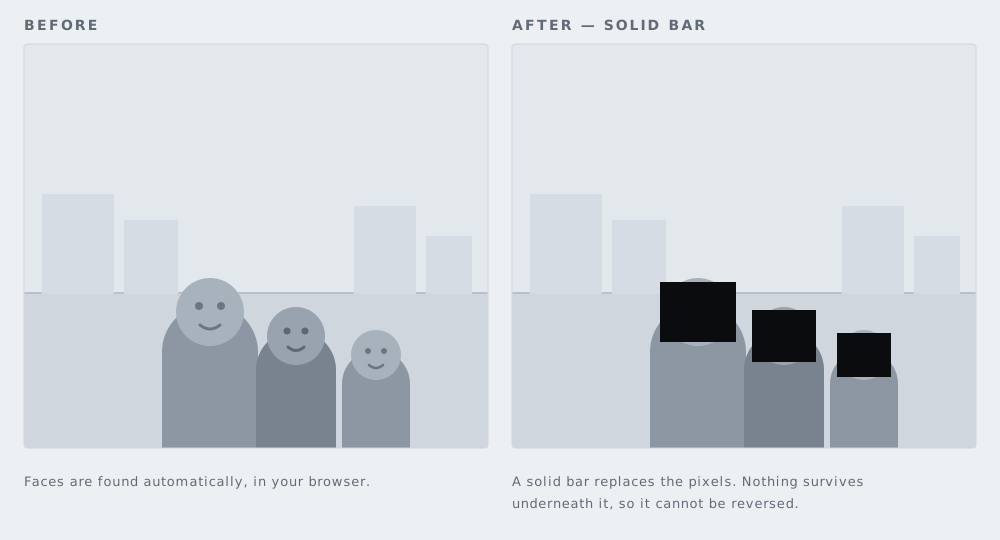
For faces, the face blur tool finds faces automatically and lets you adjust or add regions by hand, which is quicker than working through a mantelpiece full of frames. For prescription labels, envelopes, names on doors and anything else where the point is the writing, blacking the text out with a solid bar is the right choice — a blur over small text can sometimes be worked back, a solid rectangle cannot. If you are unsure which treatment fits which object, the trade-offs are set out in blur, pixelate or black box.
Plates work differently here, and it is better to say so than let you find out mid-job. There is no automatic plate detection on this site. On the license plate page you draw a box over the plate yourself. It takes a few seconds per car, and it does not miss the third car parked halfway out of frame.
Nothing you open here is uploaded. Every photo is decoded and edited by your own browser, and the edited file is saved straight back to your device. That matters when the images belong to a client rather than to you.
Where the professional obligation sits
Anyone doing residential estate agency work has to belong to a government-approved redress scheme, under the Estate Agents (Redress Scheme) Order 2008. For members of The Property Ombudsman, the Code of Practice for Residential Estate Agents that took effect on 1 June 2019 says at paragraph 1h that you must not release or use confidential information for any purpose other than the one it was given for, without the consumer's permission, unless you are legally required to. It adds that personal data should be processed in line with data protection legislation and your firm's privacy notice.
A photograph that identifies the occupier's family is information you were given access to in order to market a house. Publishing it on a portal is a different purpose from the one you were let in for. That is a more useful test than trying to remember a rule.
The same code, at paragraph 7i, requires that statements about a property — oral, pictorial or written — are accurate and not misleading. It cites the Consumer Protection from Unfair Trading Regulations 2008, which were repealed and replaced by the unfair commercial practices provisions of the Digital Markets, Competition and Consumers Act 2024 on 6 April 2025. The code's wording predates that change; the duty not to mislead did not go anywhere. Covering a face or a plate does not misrepresent a property. Removing a pylon from the view does. Rightmove draws the same line, separating light touch edits such as cropping and brightness from enhanced edits that add or remove objects, and requiring the latter to be labelled.
The longer version of the data protection side is in the guide to GDPR and photographs.
What a photo edit does not fix
Redacting the stills is the easy part. It is worth knowing what it leaves behind.
Video and virtual tours. A still-image editor cannot help here. A face on a mantelpiece sits in frame for several seconds of a walkthrough, and fixing it means re-recording or editing the video.
Floor plans. Plans drawn from the occupier's own labels sometimes come back with room names that are a child's first name. Read the plan as carefully as you read the photos.
Brochures, window cards and feeds. The same photographs go to more than one place. Replacing an image on the portal does not reprint the window card or recall the PDF a buyer already downloaded.
Metadata. Photographs from a phone can carry the coordinates where they were taken, the device, and sometimes the photographer's name inside the file. That is separate from what is visible in the picture, and worth stripping out before a batch goes to the portal.
For the checklist rather than the reasoning, the step-by-step version is in the guide to estate agent listing photos.